Up for Parole
The Idea Behind the Show
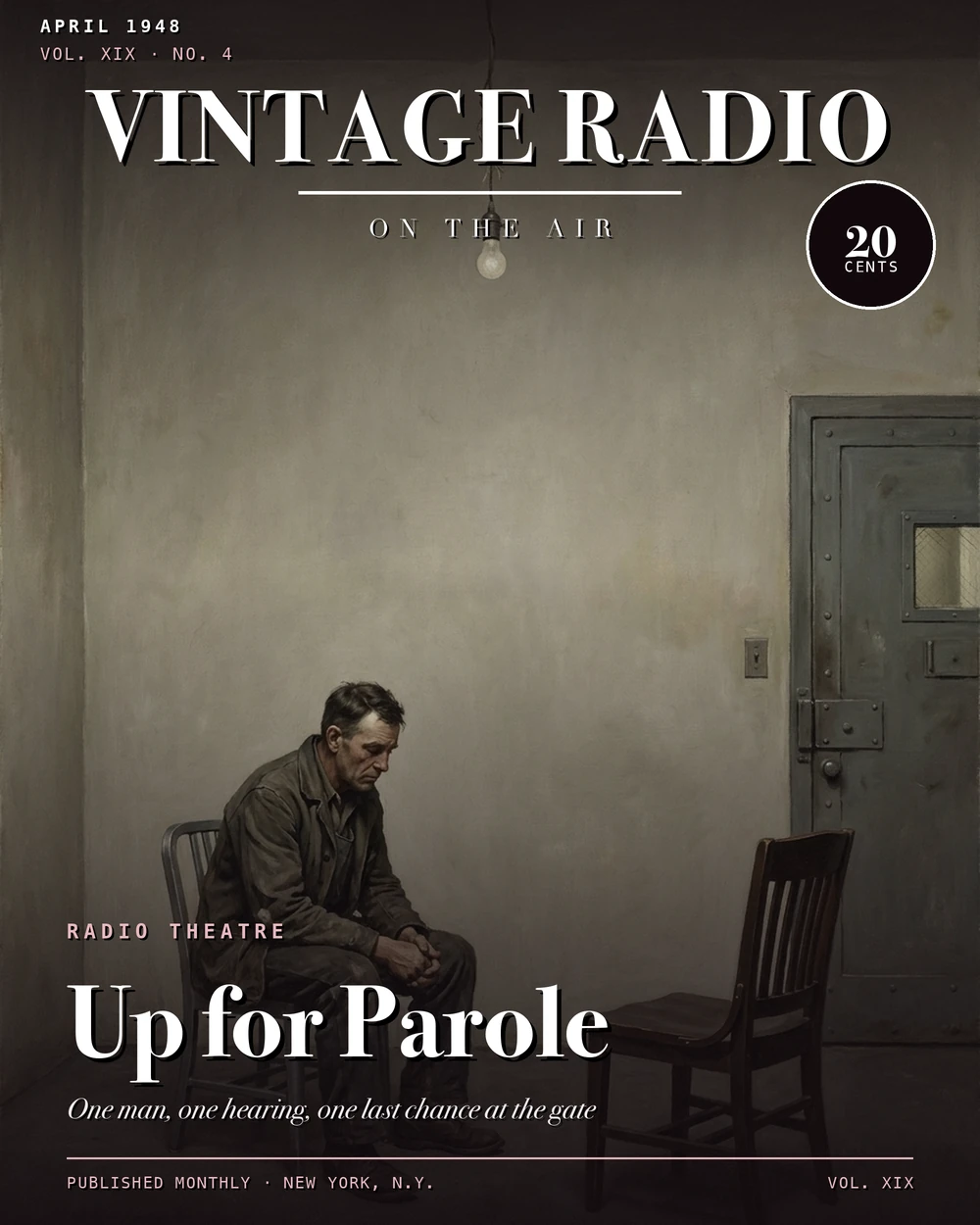
Most Crime-Detective radio programs in 1950 centered on the investigator — the detective working the case, the cop tracking the criminal. Up for Parole started where those stories ended. By the time an episode began, the crime had already happened, the conviction was on record, and the prisoner was sitting before a parole board asking to be released. The question wasn't whodunit. It was: does this person deserve a second chance?
That shift in perspective gave the show a moral weight that straightforward crime dramas rarely carried. Each episode dramatized a life story drawn from the official records of a real prisoner, presented to the listener as though they were sitting in the parole board room hearing the case themselves. CBS broadcast it as a sustained program — meaning no sponsor underwrote it — starting March 10, 1950, which left the production free to take its cases seriously rather than wrap them around a commercial hook.
How Each Episode Was Built
The structure was consistent across the run. An episode's title was the name of the person seeking parole — Harold Edgerton II, Margo Owens, Eddie Larson, Fern Russell, and so on through the ten known surviving episodes. Each one traced how that individual ended up before the board: the circumstances of the crime, the life that led up to it, the time served. The parole board itself appeared in each episode, hearing the arguments, asking questions, and weighing the evidence alongside the audience.
The research behind this format was real work. Wally Gould dug into the source material — official case records — and brought that raw data to the writing team: Allan Sloane, Robert Cenedella, and Arnold Perl. Their job was to take that documentary material and turn it into drama without losing the factual grounding. The show was explicit with its audience that the cases had been taken directly from official records and dramatized, rather than invented. That authenticity mattered to the premise: listeners were being asked to form actual opinions, not just follow a plotline.
The announcer framing set the tone. Harry Marble narrated the series, keeping the presentation clean and authoritative, with Bob Hite also announcing across the run. Marble was a CBS staff announcer through the early 1950s — he stayed with the network until 1955, when he left for WGAN in Portland, Maine. Harry Salter provided the music, giving the production a consistent sonic atmosphere across episodes.
The Writers
The writing team on Up for Parole was notably accomplished for a sustained program. Allan Sloane, born June 14, 1914, had won a Peabody Award in 1943 for dramatizing the Allied landing on Sicily as part of The Man Behind the Gun — work that later earned him Emmy recognition as well. He went on to write for Indictment and Top Secret, and he brought a similar documentary instinct to Up for Parole, where the facts of a case had to carry the drama.
Arnold Perl, born April 14, 1914, had written for The Big Story on NBC and The Amazing Mr. Tutt on CBS before joining this production. He was primarily a playwright and screenwriter whose most substantial pre-blacklist work came through radio. The timing matters: Up for Parole ran from 1950 to 1951, and Perl was blacklisted in the early 1950s, making this series one of his last major radio credits before that door closed. Robert Cenedella rounded out the writing staff, working alongside Sloane and Perl on a show that suited their shared interest in socially grounded drama.
Mitchell Grayson produced and directed the series, with John Dietz also taking director credits across the run.
What the Show Was Actually Asking
The questions at the center of Up for Parole weren't comfortable ones. Can a person who committed a crime genuinely change? What does a parole board actually know about whether that change is real? Is rehabilitation a realistic outcome, or is locking someone away primarily about keeping others safe? The show didn't answer these questions — that was the point. Each episode laid out the facts and dramatized the board's deliberation, then left the listener to decide where they came down.
That format put the audience in an unusual position for radio drama. The show wasn't asking listeners to root for a hero or against a villain. It was asking them to sit with ambiguity, to consider that the person in front of the board might have genuinely earned release, or might be telling a story they'd rehearsed. The moral dilemmas weren't incidental to the drama — they were the drama.
By framing these as actual cases rather than fictional inventions, the show also connected its audience to a real institutional process that most people never saw from the inside. Parole boards existed, made these decisions, and shaped lives accordingly. Up for Parole made that process visible and put listeners in the room.
The Run and What Survives
The show ran from its March 1950 premiere through October 6, 1951 — a span of roughly a year and a half on CBS. Eleven episodes are identified in the catalog, with ten recordings known to survive, running to just under five hours of total playtime. Given that the show aired without a sponsor, the relatively short run isn't surprising; sustained programming depended on the network's continued interest rather than a commercial partner's investment.
The episode list — Harold Edgerton II, Margo Owens, John Newton, Paul Botwin, Eddie Larson, Clarence Hogan, Thomas Hostey, Tyler Graham, Fern Russell, Clinton Foster — reads like a cross-section of the kinds of cases a real parole board would hear: men and women from different circumstances, representing different crimes and different arguments for release. Whatever the outcomes in those fictionalized hearings, the show treated each case as worth examining carefully rather than as a moral foregone conclusion.
For a program that ran fewer than two years on an unsponsored basis, Up for Parole assembled a remarkably skilled team and built something genuinely uncommon — a Crime-Detective series where the mystery wasn't a murder to be solved but a human being whose future was still undecided.